
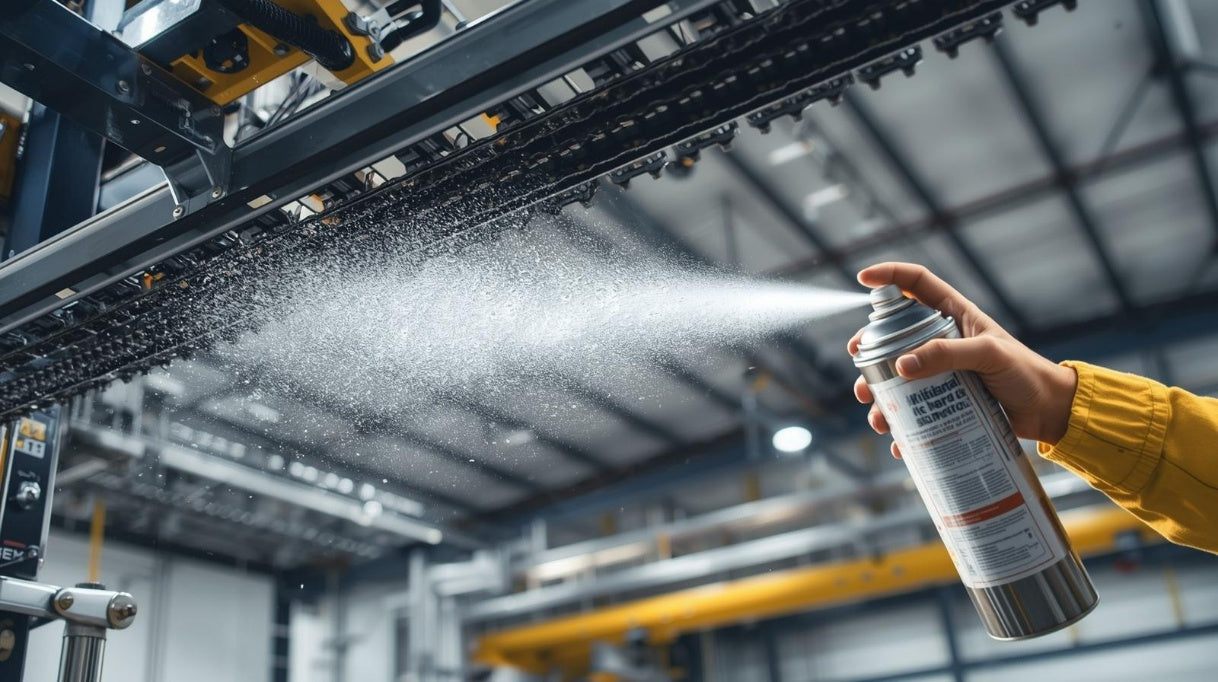
Non-drip foam lubricant

Foam grease as a lubrication technology
In lubrication technology, in addition to the classic forms—oils, solid lubricants (suspensions), and dry lubricants (dry films)—an intermediate form is also used: foam lubricants, or foam-based lubricants applied as foam or foam emulsion. Their purpose is to provide a lubricating medium in difficult-to-access conditions, with complex geometry, or where regular oil or grease might drip or be excessive.
"Foam lubricant" is a suspension of microparticles of oil-lubricant in a continuous gas-liquid phase (foam), which enables precise application, adhesion, and reduced losses (drips, spatter). Key issues include foam stability, proper distribution of oil droplets in the foam phase, adhesion (cling) to structural components, and the subsequent transformation of the foam into a thin liquid layer, creating a lubricating film.
Foam lubrication technology is used in food processing plants, overhead applications (i.e., above the heads of production lines), in places where grease cannot drip onto the product, or where metal-to-metal contact requires protection but traditional grease would be excessive or inconvenient.
I will discuss the considerations on foam lubrication based on the top product in this group, BDF CLING LUBE Spray by JAX.
Design principles and operating mechanisms
Chemical composition and phase structure
Foam grease consists of three main components:
- Carrier/gas phase (air, nitrogen, other inert gas) - is the continuous phase in the foam in which the bubbles are located.
- Liquid phase (oil carrier or oil blend / emulsifier / diluent) - the medium carrying lubricants and additives.
- Functional additives (anti-wear, EP, anti-corrosion, foam stabilizing/defoaming agents, surfactants, antimicrobial agents) .
In simple terms, during application with a sprayer or foam system, a liquid phase with additives is aerosolized or foamed, creating bubbles with thin liquid films that transport grease/oil molecules. Upon contact with the surface of machine components, the foam collapses, and the oil "settles" and forms a lubricating film. Ideally, the foam ensures even distribution and good penetration, while the gas phase disappears (escapes), leaving a thin lubricating film.
Construction difficulties include:
- optimal gas-to-liquid volume ratio - too much foam (too much air) can lead to instability and rapid loss of lubrication,
- selection of surfactants/emulsifiers or foaming agents that support foam stability but do not interfere with the action of lubricant additives,
- ensuring that after the foam subsides (after contact with the element), an appropriate oil film of the desired thickness and mechanical strength remains.
Foam stability and foaming phenomenon
A key issue is foam stability—the ability of bubbles to maintain their structure for a given period of time, until they contact a surface and form a lubricating film. Too rapid "spreading" (bubble coalescence) can lead to uneven distribution. Excessively long-term stability can hinder the transformation of foam into an oil film or block dynamic lubrication.
Physicochemical phenomena relevant to foam lubrication are:
- surface tension of bubble membranes (the lower it is, the easier foam is formed, but it may be less stable),
- the presence of surfactants or substances that increase the viscosity of the vesicular membrane (e.g. polymers),
- bubble size distribution - smaller bubbles with a thicker membrane may be more stable, but are more difficult to release the oil phase,
- the phenomenon of gas diffusion through membranes, which gradually destroys the bubbles,
- chemical effects of additives (e.g. antimicrobial agents, antioxidants) which may affect surface tension, adsorption at interfaces, etc.
In the technical literature, foam is often compared to the phenomenon of foaming in oils (foam in lubricants) - although foam is an undesirable phenomenon there, in the case of foam lubricants it is an intended effect, but with similar limitations regarding stability and air removal.
Transition from foam to lubricating film
When the foam contacts the surface of machine components (e.g., chains, guides, gears), mechanical forces (compression, contact, gravity) cause the bubble membranes to rupture, releasing the oil/lubricant fluid, which then spreads or fills the microsurface and forms a lubricating film. It is this final film that determines the lubricating properties: load-bearing capacity, thickness, shear resistance, and durability.
If the film layer is too thin or discontinuous, surface wear, micro-wear (microbrains are microscopic damage to the metal surface caused by friction with insufficient lubrication) or seizure may occur.
Therefore, when designing a foam lubricant, it is necessary to ensure that the liquid phase after leaving the foam feeder reaches the correct mass/volume ratio and provides lubricating properties.
Tribological properties of foam lubricant and film dynamics
For a lubricating film formed from foam, the same basic principles of tribology apply as for classic oils and greases:
- load-bearing capacity (or maximum compressive pressure) measured e.g. by EP (extreme pressure) tests,
- resistance to impacts and variable loads,
- dynamic and kinematic viscosity (how quickly the film responds to regime changes),
- thermal and oxidation stability,
- resistance to removal from the surface (maintaining the film under conditions of sliding contacts and vibrations).
Since foam grease often operates in limited regimes (short pulses, intermittent contacts, sliding elements), it is necessary to select EP additives, anti-wear additives, friction modifiers (e.g. sulfur, phosphorus, molybdenum compounds) in such a way that the lubricating film formed after the foam disappears is durable and mechanically resistant.
Advantages, limitations and technological challenges
Benefits of foam lubricant
1. Minimal drips / no drips - thanks to the foam application, the risk of uncontrolled oil dripping is limited.
2. Precise application - the foam can be applied pointwise, even in hard-to-reach places.
3. Raw material savings - because the application can be more efficient, oil consumption can be lower than with a classic grease.
4. Avoiding contamination of production areas - important, for example, in the food industry, where excess oil can contaminate products.
5. Good adhesion (cling) - properly designed foam can hold even in horizontal or inverted positions before turning into a lubricating film.
Limitations and challenges
1. Difficulty maintaining foam stability - too rapid coalescence of bubbles or too slow disintegration can disrupt the lubrication effect.
2. Load and speed limitations - thin lubricant films may be less effective under high load or high contact speed conditions.
3. Additive Compatibility – Surfactants, EP additives, friction modifiers and protective agents must be selected so that they do not interfere with each other or negatively affect foam stability.
4. Cost and complexity of formulation – developing a stable lubricating foam requires advanced chemistry and optimization testing.
5. Aging and degradation - under operating conditions, the foam and lubricant film may undergo chemical degradation, oxidation or adsorption of contaminants, which requires appropriate antioxidant additives and filtering agents.
6. Micro-air control / air dispersion - the presence of air and improper release of bubbles can lead to lubricant film defects and, in extreme cases, to the phenomenon of vertical air "pumping".
Example of a foam lubricant: BDF CLING LUBE Spray JAX
Product characteristics as basic properties
JAX BDF Cling-Lube is an industrial foam lubricant designed for use in industrial plants and, thanks to its NSF H-1 certification, also in food processing plants. Typical applications include applications where lubricant must not drip onto products.
Important features of this product include:
- Extreme cling : designed to allow the foam to adhere to the surfaces of guides, chains, carriages, moving parts – even in a vertical or overhead position.
- Foam formula (foaming, no-drip, dense foam) : the product has foaming properties, which helps in controlled application and prevents dripping.
- EP/Anti-wear additives : the product contains extreme pressure and anti-wear agents to support the lubrication function, even under heavy loads.
- Corrosion protection and environmental durability - contains additives that inhibit corrosion even in high humidity conditions.
- Contains Micronox® – antimicrobial technology, important for applications in the food industry (microbiological risk reduction).
- NSF H1 registration - qualifies and allows the product to be used also in food plants, where incidental contact with the food product should not pose a hazard.
- Drip-free application – thanks to the “no drip” formula, it reduces the risk of dripping and contamination.
JAX describes the product as being developed in collaboration with production line maintenance departments in meat and food plants to address the need for a lubricant that stays above the surface rather than dripping onto the products.
Jax Product Analysis as a Benchmark
We can analyze what features make BDF Cling-Lube a good benchmark for foam lubrication:
-
Foam vs. Film Balance
Producing a dense, compact foam allows the product to be applied in a controlled manner, yet still develops a lubricating film—a key feature of the BDF Cling-Lube formula. This ensures the foam "sticks" and doesn't drip before the oil has a chance to be applied. -
Matching accessories
EP and anti-wear additives are formulated and concentrated to ensure they don't disrupt the foam structure, but maintain the oil film's effectiveness. The selection of specific compounds (sulfur, phosphorus, molybdenum, etc.) must be coordinated with the foam system. -
Effective adhesion and no drips
A key feature for overhead applications is the ability to cling - BDF Cling-Lube accomplishes this by maintaining foam until an oil film can form. -
Compliance with sanitary requirements
NSF H1 registration and microbiological protection (Micronox®) make the product acceptable even in food environments. This requires that the ingredients be non-toxic and microbiologically stable. -
Convenient application in the form of a spray/aerosol
The aerosol format allows for application in hard-to-reach places where manual application of classic grease would be difficult or risky.
Possible disadvantages and limitation conditions
Even a foam lubricant product as sophisticated as BDF Cling-Lube can have limitations:
- at very high loads or contact speeds, the film may be too thin to provide a comfortable load-bearing capacity margin – then classic greases may be a better choice,
- in extreme temperature conditions (very high or very low), foam stability or additive durability may be a challenge,
- a period of regeneration/re-application is required - the lubricating film may wear off and a new foam application requires a clean surface,
- in the case of dirt, dust or surface deposits, the film may be less effective as particles may be deposited together with the oil,
- Costs – More complex chemistry and packaging (aerosol) can be more expensive than traditional lubricants.
Applications, selection criteria and testing methods
Typical areas of application
Foam grease is used wherever classic grease may be problematic or risky:
- production lines in food plants in overhead zones (overhead conveyors, trolleys, chains) - to avoid dripping onto products,
- guides and rails in vertical structures or in an inverted position,
- mechanisms in tight spaces where it is difficult to apply grease or lubricant with a brush,
- preventive applications where periodic lubrication is to be long-lasting but with minimal risk of dripping,
- situations where the lubricant must be applied quickly and the gas phase evaporate, leaving an oil film.
Criteria for selecting foam grease
When selecting or designing such a lubricant, the following should be considered:
- Range of loads and contact speeds - the lubricant film must meet the tribological requirements of the system.
- Operating Temperatures - Foam lubricant and additives must be stable over the operating temperature range.
- Environmental conditions – moisture, dust, chemicals, corrosive factors – require appropriate additives.
- Dwell time - The amount of time the foam must hold before it turns into a film.
- Material compatibility – with seals, coatings, materials of construction to prevent chemical reactions or degradation.
- Sanitary/Regulatory Requirements – In food or medical applications, the lubricant must be food grade or certified.
- Frequency of regeneration/application - depending on the intensity of use.
Testing and evaluation methods
In the foam lubrication technique, a combination of methods is used:
- Foam tests – analogous to oil foam tests (e.g. ASTM D892) to assess foaming ability and foam stability.
- Foam Decomposition and Coalescence Time Analysis – A measurement of how quickly the foam collapses and how long the bubble structure persists.
- Film tests – tribological tests of friction and load-bearing capacity of the lubricant film obtained after foam disappearance (pin-on-disk, EHD tests, EP tests).
- Chemical durability tests – thermal aging, oxidation, analysis of additive content after work cycles.
- Adhesion/Cling Tests - Testing whether a foam lubricant adheres to surfaces in various orientations (vertical, inverted, diagonal).
- Experimental field testing – application under production conditions and observation of durability and effectiveness.
Practical tips and development prospects
- When developing a foam lubricant, it is worth conducting iterative tests: adjusting the gas-to-liquid ratio, modifying the surfactant composition, testing under stress conditions.
- Integration with automatic foam lubrication systems (sprays, foam injection) can increase application efficiency.
- Research on new surfactants, nanoparticles, microcapsules and intelligent additives (e.g. temperature-responsive) can increase the stability and effectiveness of lubricating foams.
- Monitoring the condition of the lubricant film (e.g. sensors, friction measurements) can enable adaptive foam application as needed.
- In the context of sustainable development, we can strive for biodegradable formulations that are safe for health and the environment, with appropriate certificates.
If you're interested in foam lubricant, let us know what you're lubricating and under what conditions, and we'll select the right product for you. You can also choose the product yourself in our store: https://sklepsmary.pl/ , call 601444 149, or order by email : sklep@elub.pl